Posts

Showing posts with the label auger drive

The Latest Auger Alignment System on the Market - HALO
Image
Have you heard of HALO, the biggest innovation in pendulum drilling in the past two decades? HALO is Digga’s brand new Auger Alignment System.  HALO has been designed to save operators time and money. It helps you drill straight holes and therefore provides a number of advantages to the earth drilling industry. Its benefits include, amongst others, reducing the number of in-hole angle adjustments which can create an oversized hole, also reducing the amount of concrete required to fill the hole. Not drilling straight can additionally cause sideload on the auger bit and drive, potentially causing damage and expensive repairs. With HALO operators drill more efficiently, as you can return to drilling faster after returning the auger into the hole. Another great advantage is you won’t need a spotter with a spirit level guiding you through the hole. So, if you’re trying to save on labour costs, HALO is the way to go - remember HALO does not take holidays or sick leave! So, how does it wo...

Digga tips: drilling in clay

Image
When you’re drilling in clay it can be difficult to remove the spoil off of the auger. It’s tempting to alternate the drive from forward to reverse to flick the clay off, but this can cause serious torque related stress on the drive gearbox which will lead to premature failure and subsequently expensive repairs. Hitting the auger against the ground can also create side load on the shaft which could in turn damage the shaft seal and gear box. In our previous blog post we explain the best way to remove spoil from your auger; using a forward, stop, forward, stop control pattern. This can often take a long time when working in clay and time costs money… Here are a number of tips to help remove the spoil from your auger when drilling in clay: Drilling another hole with the clogged auger and then reversing out of the hole will remove soil from the flights Using a single carry flight auger to avoid the clay becoming compacted between the flights Choose a steep pitched auger flig...

The Digga ECV and pile kick back when installing screw piles.

Image
Screw piles or helical piles are installed to an engineered torque specification. By the time installation torque is reached and the operator stops the machine, the screw pile has built up rotational energy - similar to a rubber band on a wind up model aeroplane. This energy that is stored in the anchor needs to be released before the drive unit is disconnected. The ECV bypasses the stored energy allowing the anchor to “unwind” in a controlled manner. Without this valve, the pressure contained when holding the pile in place would be forced up the pile and into the drive unit resulting in potential damage & costly repairs for the motor and gearbox. See the diagram below, the red arrow demonstrates the force of the energy up the screw pile. Digga's flow reversal bypass valve (Energy Control Valve - ECV) is fitted as standard to Digga Screw Anchor Drives and can be retro fitted to drilling drives as required. The Digga ECV effectively protects the motor in your dr...

Over 30 years of Digga attachments - Ron’s Landscaping

Image
Machinery and earthworks-enthusiast Ron Bates from Ron’s Landscaping tells us he’s been involved in the industry over 30 years. Being a very brand-loyal Aussie bloke, Ron swears by two brands he has stuck with over the years - Bobcat for Skid Steer Loaders and Digga for machinery attachments. “The reason I chose Digga was because I couldn’t justify the price of the other attachments on the market compared to the quality. And seen my Digga attachments are still running today, it was well worth it! I started off with a PD3 and an auger to fit my machine 30 years ago. Not long after purchasing another few augers, I bought a trencher and a slasher – which are now over 20 years old too.” Being involved in the industry for so long, he sure has some great experience and likes to get the most out of his attachments. “I do all types of machine-work now, from digging dams to clearing, rural fencing, trenching for farmers, plumbers, electricians – basically anyone who needs some help diggi...

Digga tips - when to rotate picks and change the teeth in your rock auger.

Image
You will at some point need to replace your auger teeth , when is dependent on how often they are used, how they are looked after and the ground conditions they are being used. However, the teeth on your auger should be changed as soon as reasonable wear is noticed and before any pocket wear occurs. The productivity of the auger will decrease as the efficiency of the teeth wears. The outside teeth are travelling the greatest distance as they follow the rotation of the circumference of the augers diameter so they will wear out much quicker than those towards the centre. This is because they have not been travelling as greater distance. The most common sign of wear is to the outer tips of the tooth and this wear will follow the radius of the diameter. If you continue to wear through your outer teeth, you will begin to wear into the pockets and the flights of the auger. It is important to check your teeth regularly to work productively and efficiently. If you find yourself in a r...

Digga drive key features (up to PD50)

Image
Digga’s range of screw anchor and auger drives are the ultimate in performance, quality and cost effectiveness. With over 30 years of design and development, working in the field and listening to the needs of our customers to exceed their expectations. All Digga drive units are manufactured in Australia, by Digga - from the hood on the drive to the gear box and Eaton motor. Our drives feature key design modifications to stand them apart from the competition: Integrated motor and output housing unit Our custom designed hydraulic motors were developed in conjunction with Eaton, using Eaton Geroler technology. Not satisfied with an off-the-shelf motor we developed the design specifically for the earth moving industry; significantly reducing the weight and overall length of the drive unit by integrating the hydraulic motor into the actual housing. Merging the motor with the input housing creates a direct connection to the gearset and eliminates the need for several gearbo...

Digga tips - the importance of vertical alignment when drilling.

Image
Having trouble drilling? The correct vertical alignment of your auger into the ground is essential to ensure efficient & effective drilling with your excavator. The natural arc movement of the boom causes the dipper arm to move out of alignment as it is raised or lowered, which is why constant operator adjustments are required to maintain vertical alignment. Please consider, that failure to do so will create significant side load on the auger drive and auger! As Digga auger drives are pendulum drills designed to hang freely from the excavator mount - excessive side load may result in bent auger flights, pipe and hubs as well as potential damage to the auger drive shaft, seals and gearbox. When you are drilling especially into hard ground this may also  cause socket and pilot breakage. So make sure to align your auger and drive correctly, to avoid damager and drill which much better performance. You can find more info and tips for drilling in harder grounds such as rock or...

Digga tips - servicing and changing the oil of your Digga drive unit.

Image
It is important to service your Digga drive unit and change the oil regularly as per the owners manual. This will ensure longevity and performance of your drive. The oil in your drive unit is independent to your hydraulic system. Oil from your machine does not lubricate your drive unit. As a result your auger drive requires regular oil changes to remain in perfect working condition. The images below illustrate the importance of regular servicing of your auger drive in accordance with the owners manual. The 3 drive units were tested in our Hydraulic Cyclic Testing Unit where 10 years of wear and tear was simulated. Oil was changed in the drives at different intervals illustrating the wear caused by neglect. Changing the oil and a regular service of your Digga drive unit is crucial to its longevity and performance. For more information on the Digga Service offering visit  www.digga.com/service-spares

Digga tips - best practice when drilling in rock.

Image
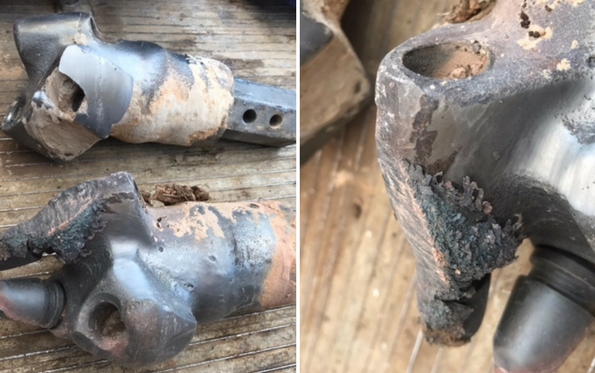
Are you having trouble drilling in hard rock? We can help you out with some tips to make your job easier.. and more efficient! Without damaging your drillhead or wearparts. Let us explain why rock drilling may cause difficulties and issues when not carried our correctly: When drilling rock or frost for extended periods of time, air is trapped in the hole creating an oven effect. The trapped temperature and friction causes the wearparts and pilot to heat up to an extreme temperature, causing them to melt. It will damage the drilling head and can result in the face of the rock to 'glaze over' and become an even harder surface. This is why we recommend that you periodically remove the auger from the hole to allow fresh air back in the hole every 5 minutes. This means - stop drilling and bring the auger head to the surface to allow air into the hole. Below is an example of an auger, which was left down the hole for too long. While it may seem excessive to have to bring ...

Why choose a 2-speed drive over a single speed drive?

Image
If you’re working with multiple sized augers or often in different ground conditions you’ll understand the expense and time wasted that comes with needing multiple drive units for the different applications. When the ground is soft you want a higher speed to get the hole drilled quickly and then move onto the next one. When the ground is hard or you’re using a large auger you need torque to get the job done efficiently. Speed and torque are always a trade-off; when you increase your speed you lose power and when you increase your power, you lose speed. Similar to a manual car, fourth gear allows speed but struggles with the power required to get the vehicle up the hill Standard, single speed drives are typically manufactured as a cost effective solution to provide a speed and torque to suit most applications but will give you one or the other. 2 speed auger drives have grown in popularity over the last few years and, as leading manufacturers, we can understand why. We unde...

Digga DR range of augers

Image
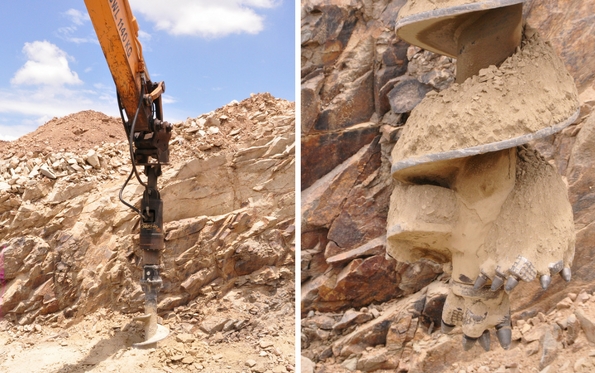
Digga's dedicated rock augers (DR) require constant maintenance to remain effective. The teeth must be free to rotate inside the pocket. Teeth that stop rotating will be inefficient and wear out faster causing damage to the tooth pockets and flights. In the video below, Queensland Sales Manager Anthony Wieckmann talks to you in detail about our dedicated rock augers – the tool you need if you’re drilling into hard fracturable grounds. Tips when drilling in rock When drilling in rock for extended periods of time air is trapped in the hole creating an “oven”. This can cause the face of the rock to glaze over and become even harder. For this reason, you should stop drilling and allow fresh air back in the hole approximately every 5 minutes. As you stop drilling, bring the auger to the surface and allow fresh air back down the hole. Remove any spoil from the auger and inspect the teeth and pilot for wear and that they can turn freely in their pocket. For more informat...

Custom builds to meet customer requirements

Image
Hypower Hydraulics are a Digga reseller from New South Wales. They specialise in hydraulics, but they often have a customer requirement for drilling and screw anchor drives with high power and high torque – although never the ‘standard’ requirements. Manual Geldes, the business owner, explained that his customers often call up for the “weird and wonderful” and it is his long-standing relationship with Digga Australia and his trust in our manufacture that allows him to meet their requirements. Hypower Hydraulics request custom drives for different ground conditions or specific screw anchoring applications. They most recently called upon Digga when they needed a drive with a specific gear ratio that would allow their customer to achieve the desired speed and torque output to complete a job. In this instance, they opted for a custom drive which features a custom gearset configuration tested to achieve the specification. In the past, they have relied on the team at Digga for varia...

The Digga auger range

Image
The right auger for the right ground condition is key to working productively. Here we have a brief overview of the 3 different 'standard' auger ranges Digga manufacture. 'A' or 'earth' range of augers Digga's A augers are efficient in cutting through earth, clay and soft ground as it uses flat teeth to peel up the layers. Our A augers have 3 teeth options within the range to aid wear; the standard earth tooth, flat carbide tooth or raised carbide tooth option.  'RC' or 'rock combo' augers Digga's RC range of augers uses a tapered tooth which can be used on rocky/ earthy grounds. The tungsten tipped teeth helps to rip into the ground.  'DR' or 'rock' augers Dedicated rock augers are ideal for bursting into material such as shale or rock. They use a pick tooth to break and fracture into the ground.  Watch our video of Anthony giving a brief overview of the range here:  ...

Digga gear oil - now available!

Image
Do you need to service your Digga drive but not located near one of our service centres? You can now purchase Digga gear oil in 1l, 2/5l and 5l bottles so you can service your Digga attachments from the convenience of your yard or shed. The oil in your drive unit is independent of your machines hydraulic system. As a result, your auger drive requires regular oil changes to remain in its optimal working condition - just like your car or motorbike. Failure to change the oil will reduce the life of your attachments. Digga gear oil is specially designed for Digga gearboxes; tried and tested with Digga attachments working in earthmoving applications, in the diverse Australian climate. Our 320 extreme pressure gear oil is now available to purchase in 1l, 2.5l and 5l bottles. Changing the oil is simple. Just follow our step by step video guide:  While there are no provisions to check the level of your gearbox oil on your Digga drive; if you are working in moder...

Get your fencing in line.

Image
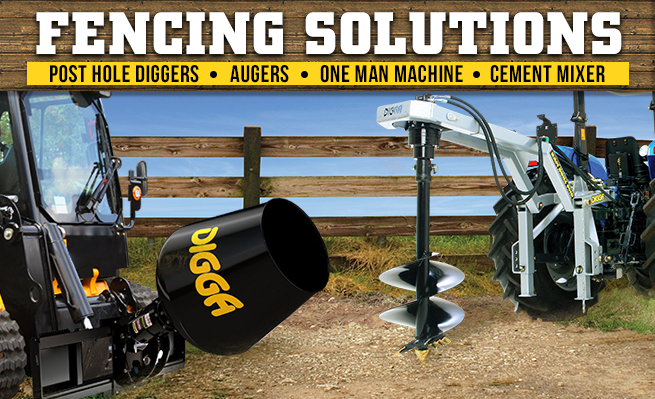
From one-man post hole diggers , augers and cement mixers suitable for tractors, telehandlers and skid steer loaders; take advantage of Digga's range of fencing solutions before the start of the season. Whether your fences are containing livestock, subdividing your land or keeping your neighbours out, Digga fencing attachments will take the hard work out of installing strong, stable fence post holes. LEARN MORE

Digga launch spare parts website

Image
If you're servicing or completing regular maintenance on your Digga machinery attachments, you may need to replace parts and components to keep your attachment. Our new spare parts section is easy to access and straightforward to use: Find your attachment Select your required part  Get a quote from Digga Visit our new spare parts section on the website here: www.digga.com/service-spares Please note that only our current machinery attachments of our core products are currently listed. Updates are being made weekly to keep the system up to date. Easily identify your parts. With exploded view diagrams of all our machinery attachments, it is easy for you to identify the parts and components of our attachments. Each part and component is highlighted by a reference number so that you can pinpoint exactly what you require. Australian manufacturing. At Digga Australia, we manufacture our machinery attachments right here in Brisbane, Queensland. We have a high volu...

Reuben Excavations in Melbourne's south east choose Digga auger drive

Image
Choosing a Digga auger drive Business owner and operator Brad spoke to us about their Digga auger drive and decisions for choosing Digga. They have owned a Digga PD4 auger drive and a number of differently sized augers for the last 5 years. They chose Digga because they wanted a well-known brand that produced a quality product range and with a good reputation. Brad uses their Digga auger drive to drill holes for stumps and posts, deep piles to form anchors for historic buildings, light towers and fence posts. Brad's comments on the Digga auger drive: I use the auger drive on our 3.5-ton excavator and I can trust our PD4 and I can trust the support from Digga Australia. Digga wants to be there for the customer long after you’ve purchased it. When the time came to give our drive a service and going over, the staff at Digga were more than helpful- they shared the knowledge they had about other customers experience and shared tips on best practice and wha...

Maintenance for you Digga drive unit

Digga drilling drives. Digga's range of premium drilling auger drives are the ultimate is performance, quality and cost effectiveness.  Ideally suited to drilling and auguring applications in most ground conditions, the Digga drive range is completely manufactured and assembled by Digga in Yatala, Queensland. Maintenance for your Digga drive unit. In this video, Mark talks you through the maintenance checks you can make to your Digga drive unit. Before each use you should check the following: Make sure all nuts and bolts are in place and secured tightly Make sure all other fasteners are in place and secured  Check all hydraulic connections are tight and that there are no leaks  Ensure all your safety signs are in place and visible  Check externally for oil leaks  Check the pins, bushes and linkages for wear and tear If you need to make any repairs or maintenance to your drive unit please refer to your user manual for guidance or contact your ...

Level Cut Excavations approve the Digga PD12 drive unit

Image
Level cut excavations Doug Sparkes is the owner of family run business Level Cut Excavations in Hastings, Victoria. His company can do any kind of earth moving or excavation and specialise in screw piles and bored piers. Doug uses the Digga PD12 fitted with a standard double pin hitch connected to his 5.5 tonne Kubota excavator. To install screw piles to a max torque of 11,268Nm Doug had the Digga ECV retrofitted to his drive. Digga ECV Also known as the swoosh valve, the ECV turns a standard auger drive into a screw anchor drive. In doing so, it protects the gearbox and motor in your drive from the rapid decompression of oil and pressure build up after achieving required torque.  By the time installation torque is reached and the operator stops the machine, the screw pile has built up rotational energy - similar to a rubber band on a wind up model aeroplane. This can cause the pile to momentarily 'kick back' and force the energy back up the screw pile through...

Drilling expert uses Digga 2-speed auger drives.

Adrian Eagan, aka Baldy has been drilling in one form or another all his working life. Working for one of Queensland largest earthmovers L&D Earthmoving , we wanted to hear what he makes of the Digga drives he puts to work every day.   L&D Earthmoving were established in 1954 and Baldy has been with them for the last 25 years explaining that the company service a mix of commercial and domestic customers “from backyard bobs to major infrastructures – there is virtually no where we can’t service!” Covering all of South East Queensland working in light dusty sands and clay to solid blue metal Baldy really puts his drives through their paces. “I run a few 4.5 or 6 tonne combos for all our everyday work and light duty drilling with the Digga PD3. Then I operate an 18 tonne excavator with a 2 speed Digga PD30.” The Digga PD30 is an upgrade from the PD18 Baldy used to operate but he admits “after 8 years of heavy work, I finally managed to break the PD18…”  Of ...