Posts

Digga tips - servicing and changing the oil of your Digga drive unit.

Image
It is important to service your Digga drive unit and change the oil regularly as per the owners manual. This will ensure longevity and performance of your drive. The oil in your drive unit is independent to your hydraulic system. Oil from your machine does not lubricate your drive unit. As a result your auger drive requires regular oil changes to remain in perfect working condition. The images below illustrate the importance of regular servicing of your auger drive in accordance with the owners manual. The 3 drive units were tested in our Hydraulic Cyclic Testing Unit where 10 years of wear and tear was simulated. Oil was changed in the drives at different intervals illustrating the wear caused by neglect. Changing the oil and a regular service of your Digga drive unit is crucial to its longevity and performance. For more information on the Digga Service offering visit  www.digga.com/service-spares

Benefits of the Digga cradle hitch

Image
The Digga excavator cradle hitch was designed and manufactured to improve operator and workers safety when manoeuvring around sites whilst also providing a simpler connection to augers and piles. The double pin hitch with drive unit cradle allows the operator to angle the drive up to 90 degrees with greater support given by the cradle so it is easier and more stable when connecting to augers or anchors. The cradle also acts as a support mechanism when manoeuvring around the work site allowing the drive unit to rest on the cradle, stopping it from swinging around over uneven terrain. Designed and manufactured to suit the size of the different drive units available, the hitch can be ordered with loose or fixed pin options and suitable for use with PD3 – PD50 Digga drive models . When drilling you should lift the cradle up and away from the drive unit. Do not drill with the cradle resting against the drive unit. This will damage the cradle hitch and your auger drive. See the co...

BGL Solutions favourite Digga Attachment - The Digga Power Rake

Image
Bruno from BGL Solutions has worked with Digga Attachments for a long time, take a look at which attachments he uses for his Landscaping business and find out why the Digga Power Rake is his favourite tool: “I’ve been involved in Landscaping at an early age back in Portugal, where I grew up, and always used to work with Digga attachments there too. When I moved to Australia in 2008, I started my business BGL Solutions in Katanning WA as a garden maintenance business. As we grew over the years, we started buying more and more machinery and equipment for landscaping. Today the business has grown to a reasonable size with a mini loader, an excavator, a skid steer loader and big industrial mowers. The Digga Attachments that we own are the Digga Power Rake for our skid steer as well as 250mm, 600mm, and 900mm augers, a bucket broom, a stump grinder and a trencher for our mini loader. The first attachment I purchased for BGL Solutions was a Digga Stump Grinder. I’ve been ...

Digga tips - best practice when drilling in rock.

Image
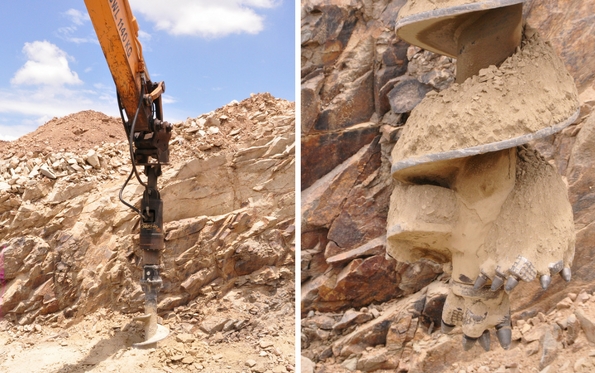
Are you having trouble drilling in hard rock? We can help you out with some tips to make your job easier.. and more efficient! Without damaging your drillhead or wearparts. Let us explain why rock drilling may cause difficulties and issues when not carried our correctly: When drilling rock or frost for extended periods of time, air is trapped in the hole creating an oven effect. The trapped temperature and friction causes the wearparts and pilot to heat up to an extreme temperature, causing them to melt. It will damage the drilling head and can result in the face of the rock to 'glaze over' and become an even harder surface. This is why we recommend that you periodically remove the auger from the hole to allow fresh air back in the hole every 5 minutes. This means - stop drilling and bring the auger head to the surface to allow air into the hole. Below is an example of an auger, which was left down the hole for too long. While it may seem excessive to have to bring ...

The Digga 4 in 1 Bucket is more than just a bucket.

Image
A Digga 4 in 1 bucket is arguably one of the most versatile earth moving attachments available for both construction and agricultural users alike. As the name suggests, a 4 in 1 bucket enables you to perform 4 different functions which Digga reference as standard bucket operation, grappling, levelling and dozing. A 4 in 1 bucket adds great value to the operators business and machinery over a standard bucket: Standard bucket operation When the bucket is fully closed the Digga 4 in 1 bucket can be used as a general purpose bucket for moving dirt and material etc. Digga tip: If you are dumping into a truck you can dump at a greater height than a standard bucket by opening the floor to release the material.  Grapple operation  With the bucket above an object, open the floor sufficiently and lower the bucket down so that the object is between the jaws. When you close the floor, the object will become clamped between jaws so you can lift and move. Digga tip: Always u...

Understanding Digga excavator hitches

Image
Digga manufacture a range of excavator hitches for machines up to 90 tonne. They were designed and manufactured to improve operator and workers safety when manoeuvring around sites whilst also providing a simpler connection to augers and piles. All our hitches are custom made to your machines requirements and vary in suitability depending on your use. Here are some key advantages of each of our excavator hitches and an explanation on how to submit an order. Digga excavator hitches Choosing from Digga’s range of excavator hitches will vary based on the application and attachment, and your machine. Below are 4 of Digga’s excavator hitches which are fully engineered and manufactured at our Yatala facility in Queensland.  Digga single pin hitch The single-pin hitch is suitable for excavators using smaller drives. It is a light weight, non-bulky option for smaller machines. This hitch can be used to fit Digga PDD to PD3 drive units on micro or mini excavators up to 3 to...

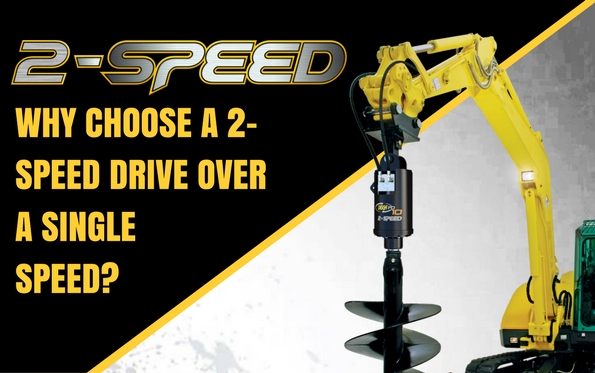
Why choose a 2-speed drive over a single speed drive?

Image
If you’re working with multiple sized augers or often in different ground conditions you’ll understand the expense and time wasted that comes with needing multiple drive units for the different applications. When the ground is soft you want a higher speed to get the hole drilled quickly and then move onto the next one. When the ground is hard or you’re using a large auger you need torque to get the job done efficiently. Speed and torque are always a trade-off; when you increase your speed you lose power and when you increase your power, you lose speed. Similar to a manual car, fourth gear allows speed but struggles with the power required to get the vehicle up the hill Standard, single speed drives are typically manufactured as a cost effective solution to provide a speed and torque to suit most applications but will give you one or the other. 2 speed auger drives have grown in popularity over the last few years and, as leading manufacturers, we can understand why. We unde...